Learning to Love Your Solitude
If you’ve recently started living alone for the first time, there’s a decent chance you’ve had a moment — maybe late in the evening, maybe on a quiet Sunday afternoon — where the silence felt heavier than you expected.
You wanted this (or maybe it’s been thrust upon you by circumstance).
You chose this (or maybe you didn’t(.
Either way, why does it feel so lonely?
First: nothing’s gone wrong.
Living alone is a transition. Even if it’s a positive one. Even if it’s something you’ve been looking forward to. You’ve moved from a life with built-in presence — someone in the next room, the background noise of another person moving through the house, a shared meal, a casual “How was your day?” — into one where all of that ambient connection is suddenly gone.
It’s not just that you’re alone. It’s that the scaffolding has disappeared.
Meals used to be shared by default. Now they’re not.
Evenings used to include someone else’s presence. Now they don’t.
Weekends used to have built-in plans, or at least company. Now it’s just… space.
And space, when you’re not used to it, can feel empty.
That doesn’t mean living alone isn’t for you. It means you’re learning a new way of living — one where the rhythms of your day aren’t provided by someone else’s habits or schedule.
You’re learning how to:
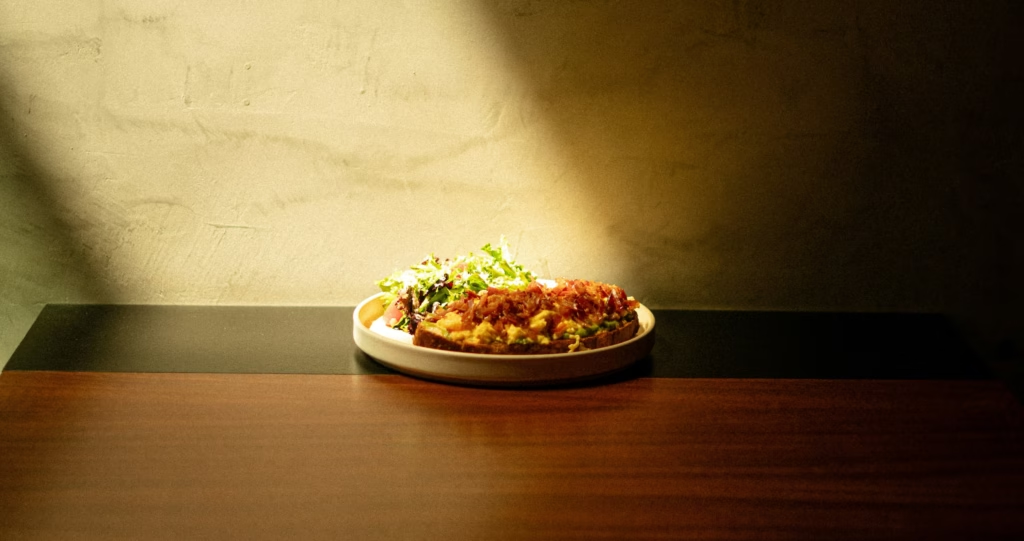
- Cook for one without it feeling pointless.
- Watch a show without someone to react to it.
- Fill your evenings in a way that feels satisfying rather than just distracting.
- Sit in silence without immediately reaching for your phone.
None of this is automatic. It takes time.
Solitude is a skill.
At first, the quiet might feel uncomfortable. Home might feel less like a refuge and more like a waiting room. You might find yourself wondering if you made a mistake, or if this is just something to get through until life becomes more “normal” again.
That’s common.
What changes things — slowly, almost imperceptibly — is the development of routines that are yours alone. Your morning coffee. Your evening walk. Your Friday kitchen reset. The music you play while you tidy up on a Sunday.
Little rituals that give shape to your time.
Eventually, the silence stops feeling like absence and starts feeling like peace. The space stops feeling empty and starts feeling open. Your home becomes somewhere you live, not somewhere you wait.
You may still feel lonely sometimes. Everyone does — even people who live with partners or families.
But living alone doesn’t have to mean living in that feeling.
It just means you’re at the beginning of learning how to enjoy your own company.
And like any new skill, it gets easier with practice.